
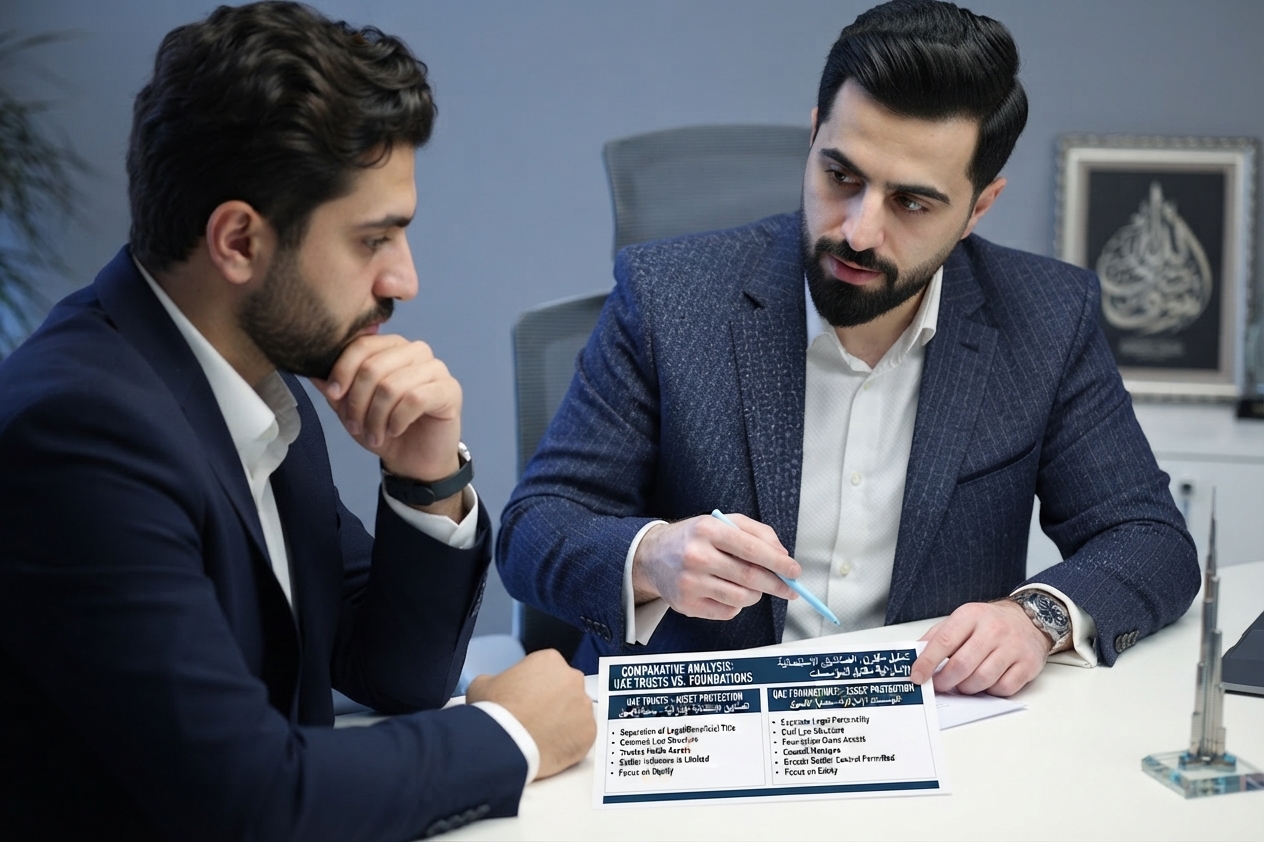
A UAE trust and a UAE foundation are different legal arrangements. A trust generally separates legal title held by a trustee from beneficiary interests; a foundation is a separate legal person governed through its constitutional documents and council. Neither automatically protects assets, changes foreign tax or succession rules, or guarantees bank access.
Educational disclaimer: This article is general educational information, not legal, tax, investment, banking, immigration or regulatory advice. UAE and foreign rules, bank requirements and registrar practices change, and the result of any structure depends on the people, assets, timing and jurisdictions involved. Obtain advice from appropriately qualified advisers in the UAE and each relevant jurisdiction before forming an entity, creating a trust, transferring assets or relying on a succession, tax, banking or reporting outcome. No outcome is guaranteed.
The decision starts with purpose, assets, control, timing and connected jurisdictions, not registration. A live or foreseeable creditor claim, insolvency, divorce, tax enquiry or enforcement event requires advice from qualified counsel before any transfer.
This comparison is for readers weighing a structure as part of a wider ownership, succession, governance or banking question. It is not a formation-only route and cannot provide secrecy or a guaranteed tax, banking or asset-protection result.
This comparison is for readers weighing a structure as part of a wider ownership, succession, governance or banking question. It is not a formation-only route and cannot provide secrecy or a guaranteed tax, banking or asset-protection result.
Trust or foundation: first separate title, control and benefit
A conventional trust is a legal relationship. The trustee holds legal title under a trust deed and governing law. The settlor contributes property; beneficiaries may benefit; and a protector, if appointed, has only the powers given by the deed and law. Trustee duties and distribution rights depend on the actual arrangement.
A foundation is a separate legal person or corporate body under its named regime, governed through a charter, by-laws and council. Appointment, removal, beneficiary and reserved-power provisions depend on the documents. The founder does not automatically retain control, and legal personality is not creditor immunity.
That distinction is central to UAE asset-protection planning: compare title, control, transfer path and evidence against the actual risk.
A foundation is a separate legal person or corporate body under its named regime, governed through a charter, by-laws and council. Appointment, removal, beneficiary and reserved-power provisions depend on the documents. The founder does not automatically retain control, and legal personality is not creditor immunity.
That distinction is central to UAE asset-protection planning: compare title, control, transfer path and evidence against the actual risk.
What “UAE trust” means in practice
“UAE trust” may mean a DIFC, ADGM, federal or foreign-law trust. These are not interchangeable.
DIFC and ADGM trust frameworks
DIFC has a statutory trust regime under Trust Law 2018, DIFC Law No. 4 of 2018, separate from its foundation regime. The deed, trustee powers, beneficiary rights and protector arrangements require review.
ADGM recognises trusts through its applied English-law framework. The relevant instruments include the Application of English Law Regulations 2015 and the Trusts (Special Provisions) Regulations 2016. Title to a mainland or foreign asset still requires checks on where the asset is located (its situs), whether the registry and lender accept the transfer, and whether other countries will recognise the arrangement.
The search phrase “DIFC trust vs ADGM foundation” usually refers to a trust in the DIFC context compared with an ADGM foundation. ADGM also recognises trusts under its common-law framework, but an ADGM foundation is a separate registered legal-person regime.
DIFC has a statutory trust regime under Trust Law 2018, DIFC Law No. 4 of 2018, separate from its foundation regime. The deed, trustee powers, beneficiary rights and protector arrangements require review.
ADGM recognises trusts through its applied English-law framework. The relevant instruments include the Application of English Law Regulations 2015 and the Trusts (Special Provisions) Regulations 2016. Title to a mainland or foreign asset still requires checks on where the asset is located (its situs), whether the registry and lender accept the transfer, and whether other countries will recognise the arrangement.
The search phrase “DIFC trust vs ADGM foundation” usually refers to a trust in the DIFC context compared with an ADGM foundation. ADGM also recognises trusts under its common-law framework, but an ADGM foundation is a separate registered legal-person regime.
Federal trust framework and foreign-law trusts
The UAE has a federal statutory trust framework alongside DIFC and ADGM. Federal Decree-Law No. 31 of 2023 Concerning Trust is active and effective from 30 September 2023. Cabinet Resolutions 137 and 141 of 2023 address trust-instrument accreditation and registration and professional trustees.
The authority, route and legal effect must be confirmed for the intended Emirate, trust form and asset. The federal framework does not automatically govern DIFC or ADGM trusts or create a universal mainland register. A foreign-law trust may form part of a UAE-coordinated structure, subject to governing-law, tax, reporting, banking and foreign-counsel review.
The UAE has a federal statutory trust framework alongside DIFC and ADGM. Federal Decree-Law No. 31 of 2023 Concerning Trust is active and effective from 30 September 2023. Cabinet Resolutions 137 and 141 of 2023 address trust-instrument accreditation and registration and professional trustees.
The authority, route and legal effect must be confirmed for the intended Emirate, trust form and asset. The federal framework does not automatically govern DIFC or ADGM trusts or create a universal mainland register. A foreign-law trust may form part of a UAE-coordinated structure, subject to governing-law, tax, reporting, banking and foreign-counsel review.
What a UAE foundation changes
DIFC, ADGM and RAK ICC foundations are separate regimes. Each uses a separate legal person or corporate entity, constitutional documents and council-based governance, but administration differs.
A DIFC foundation is a body corporate. Article 10 addresses legal personality, Articles 22–24 the council and related roles, and Article 24 permits, but does not universally require, a registered agent. Registered-office and accounting-record requirements also apply.
An ADGM foundation is a separate legal entity under regulation 3. It requires at least two councillors, an ADGM registered office and, for a non-exempt foundation, an ADGM-licensed Company Service Provider unless an exemption applies.
A RAK ICC foundation is a separate corporate entity under regulation 4, with at least two council members, a registered-agent and UAE-office framework, accounting records and an annual return. None guarantees bank acceptance, transfer approval or protection.
For UAE foundation asset protection, the relevant questions are transfer timing, solvency, where the asset sits and the chosen regime—not the label alone. For regime detail, see DIFC versus RAK ICC foundation regimes and RAK ICC foundation asset-protection considerations.
A DIFC foundation is a body corporate. Article 10 addresses legal personality, Articles 22–24 the council and related roles, and Article 24 permits, but does not universally require, a registered agent. Registered-office and accounting-record requirements also apply.
An ADGM foundation is a separate legal entity under regulation 3. It requires at least two councillors, an ADGM registered office and, for a non-exempt foundation, an ADGM-licensed Company Service Provider unless an exemption applies.
A RAK ICC foundation is a separate corporate entity under regulation 4, with at least two council members, a registered-agent and UAE-office framework, accounting records and an annual return. None guarantees bank acceptance, transfer approval or protection.
For UAE foundation asset protection, the relevant questions are transfer timing, solvency, where the asset sits and the chosen regime—not the label alone. For regime detail, see DIFC versus RAK ICC foundation regimes and RAK ICC foundation asset-protection considerations.
Decision matrix: which legal form fits which fact pattern?
The matrix is a starting point, not a personal recommendation. Facts and connected jurisdictions can change the analysis.
Verify current law, registrar process, asset-transfer requirements and connected-country advice before implementation. Read the final column first, then test the proposed fit against the protection, banking and foreign-compliance columns. For the separate three-way question, see the UAE foundation, trust and holding-company comparison. A holding company may be relevant where corporate ownership is the primary job, but is outside this binary matrix.
The right outcome may be a trust, a foundation, an existing-structure review or no new vehicle. If the answer depends on your assets, control, timing and connected jurisdictions, a Cross-Border Wealth Structuring / Foundation Review maps those facts before any choice.
The right outcome may be a trust, a foundation, an existing-structure review or no new vehicle. If the answer depends on your assets, control, timing and connected jurisdictions, a Cross-Border Wealth Structuring / Foundation Review maps those facts before any choice.
Asset protection is conditional: timing, solvency and claims matter
A structure should not be selected because a search result presents a “Dubai asset protection trust” as a complete answer. The question is whether the arrangement withstands the rules applying to the people, property, liabilities and forum involved.
For DIFC foundations, Articles 14(2)–(4) require an intent to defraud a creditor at the time of transfer plus insolvency or insufficient property to satisfy the claim before a court can act; Article 53A adds a three-year period for specified actions. For ADGM foundations, section 33 allows a court to declare a transfer void to the extent of a creditor’s claim where the founder was insolvent or intended fraud, with the burden on the creditor; sections 32–34 contain no universal three-year look-back. For RAK ICC foundations, regulations 7(2)–(4) set related conditions and regulation 68A covers specified proceedings within three years, not every claim type.
DIFC Article 70, ADGM sections 40–41 and RAK ICC regulation 54 address insolvency, dissolution or liquidation. Separate legal personality is not immunity from a foundation’s liabilities.
Common-law fraud-on-creditor analysis is fact- and jurisdiction-dependent. A live or foreseeable claim, insolvency, divorce, tax investigation or enforcement event requires counsel before any transfer. See a cross-border capital-protection review where enforcement spans jurisdictions.
For DIFC foundations, Articles 14(2)–(4) require an intent to defraud a creditor at the time of transfer plus insolvency or insufficient property to satisfy the claim before a court can act; Article 53A adds a three-year period for specified actions. For ADGM foundations, section 33 allows a court to declare a transfer void to the extent of a creditor’s claim where the founder was insolvent or intended fraud, with the burden on the creditor; sections 32–34 contain no universal three-year look-back. For RAK ICC foundations, regulations 7(2)–(4) set related conditions and regulation 68A covers specified proceedings within three years, not every claim type.
DIFC Article 70, ADGM sections 40–41 and RAK ICC regulation 54 address insolvency, dissolution or liquidation. Separate legal personality is not immunity from a foundation’s liabilities.
Common-law fraud-on-creditor analysis is fact- and jurisdiction-dependent. A live or foreseeable claim, insolvency, divorce, tax investigation or enforcement event requires counsel before any transfer. See a cross-border capital-protection review where enforcement spans jurisdictions.
Banking and registry interface: the legal owner is only the beginning
A foundation may be easier to explain as one registered title-holder with a certificate, constitutional documents and council authority, while a trust may require fuller explanation of its parties and authority. This is an operational observation, not a preference or guarantee; the bank still conducts its own customer due diligence (CDD) and may ask for equivalent or additional evidence.
The CBUAE Guidance for Licensed Financial Institutions Providing Services to Legal Persons and Arrangements, effective 7 June 2021, sets a risk-based expectation that banks understand ownership, control and purpose. Due diligence may cover source-of-wealth, source-of-funds, authority, tax-residence, expected-activity and asset evidence. Ultimate beneficial owner (UBO) and controlling-person details must be accurately disclosed to relevant registrars, banks and authorities; lawful disclosure and monitoring cannot be avoided.
Prepare the file before relying on an account application. See source-of-wealth documentation for UAE banking readiness and UAE private-banking readiness.
DLD registration and ownership remain subject to Dubai real-property rules. A foundation may be a candidate title-holder only where DLD, ownership rules, developer or lender and transfer route permit. The reviewed material does not establish a universal acceptance rule for DIFC or ADGM foundations. Confirm eligibility, title registration and the transfer route with DLD and the relevant developer, lender and advisers for the specific asset. The reviewed official material also does not establish a standalone public ADGM trust registry equivalent to the foundation register; confirm current records and treatment before implementation.
Banking evidence can also change the structure decision. Where ownership clarity, source-of-wealth evidence or KYC readiness is unresolved, a Cross-Border Wealth Structuring / Foundation Review can test whether the file supports the intended vehicle.
The CBUAE Guidance for Licensed Financial Institutions Providing Services to Legal Persons and Arrangements, effective 7 June 2021, sets a risk-based expectation that banks understand ownership, control and purpose. Due diligence may cover source-of-wealth, source-of-funds, authority, tax-residence, expected-activity and asset evidence. Ultimate beneficial owner (UBO) and controlling-person details must be accurately disclosed to relevant registrars, banks and authorities; lawful disclosure and monitoring cannot be avoided.
Prepare the file before relying on an account application. See source-of-wealth documentation for UAE banking readiness and UAE private-banking readiness.
DLD registration and ownership remain subject to Dubai real-property rules. A foundation may be a candidate title-holder only where DLD, ownership rules, developer or lender and transfer route permit. The reviewed material does not establish a universal acceptance rule for DIFC or ADGM foundations. Confirm eligibility, title registration and the transfer route with DLD and the relevant developer, lender and advisers for the specific asset. The reviewed official material also does not establish a standalone public ADGM trust registry equivalent to the foundation register; confirm current records and treatment before implementation.
Banking evidence can also change the structure decision. Where ownership clarity, source-of-wealth evidence or KYC readiness is unresolved, a Cross-Border Wealth Structuring / Foundation Review can test whether the file supports the intended vehicle.
Tax, CRS and foreign compliance are separate decision gates
The FTA’s Taxation of Family Foundations guide (CTGFF1, June 2026) treats “Family Foundation” as a Corporate Tax concept, not a general entity type. Under that guidance, an incorporated foundation or trust is initially treated as a separate legal person. An unincorporated DIFC or ADGM trust is treated as an unincorporated partnership and is transparent by default, with income attributed to beneficiaries. Transparent treatment for a separate legal person or incorporated trust is available only if the Article 17 conditions and approval requirements are met.
Conditions include identified or identifiable natural-person or public-benefit beneficiaries, an asset-management principal activity, no disqualifying Business Activity and no principal Corporate Tax avoidance purpose. The guide does not settle foreign tax classification. “Family Foundation” is not a general legal form or automatic transparency.
Registration, a UAE visa, bank account or tax-residency certificate does not by itself settle foreign residence, controlled-company exposure, settlor attribution, inheritance or reporting. CRS is not a secrecy option: trusts are analysed as legal arrangements with controlling persons including settlors, trustees, protectors and beneficiaries; foundations are classified as entities according to their facts.
MoF has announced CRS 2.0 effective 1 January 2027, with first exchanges in 2028. CARF is scheduled for 2027, with first exchanges expected in 2028. Recheck the dates before publication. See asset protection versus tax planning in the UAE; the label does not determine a tax or reporting outcome.
Conditions include identified or identifiable natural-person or public-benefit beneficiaries, an asset-management principal activity, no disqualifying Business Activity and no principal Corporate Tax avoidance purpose. The guide does not settle foreign tax classification. “Family Foundation” is not a general legal form or automatic transparency.
Registration, a UAE visa, bank account or tax-residency certificate does not by itself settle foreign residence, controlled-company exposure, settlor attribution, inheritance or reporting. CRS is not a secrecy option: trusts are analysed as legal arrangements with controlling persons including settlors, trustees, protectors and beneficiaries; foundations are classified as entities according to their facts.
MoF has announced CRS 2.0 effective 1 January 2027, with first exchanges in 2028. CARF is scheduled for 2027, with first exchanges expected in 2028. Recheck the dates before publication. See asset protection versus tax planning in the UAE; the label does not determine a tax or reporting outcome.
Before setting up a family trust or foundation: the evidence file
A request for “UAE family trust setup” is downstream of a review. Before forming an entity, creating a trust or transferring property, assemble:
The file should trace who owns each asset, who can act, where the money came from and who may benefit, and identify gaps to resolve before transfer or onboarding. A phased review or no transfer may be correct. Formation follows the evidence and connected-country constraints.
For the broader risk map, see capital protection in the UAE: what wealth owners should protect against.
- an asset, ownership and liability map, including the current legal owner and asset location;
- constitutional, shareholder and financing documents;
- any existing trust deed, wills, charter, by-laws or family agreements;
- trustee, council, guardian, director and signatory authority;
- beneficiaries, beneficiary classes, information rights and control rights;
- pledges, mortgages, transfer restrictions, pre-emption rights and required consents;
- source-of-wealth and source-of-funds evidence;
- tax-residence and self-certification facts;
- expected account activity and the commercial or family purpose of the arrangement; and
- any live claim, restriction, insolvency concern, divorce issue, tax enquiry or enforcement event.
The file should trace who owns each asset, who can act, where the money came from and who may benefit, and identify gaps to resolve before transfer or onboarding. A phased review or no transfer may be correct. Formation follows the evidence and connected-country constraints.
For the broader risk map, see capital protection in the UAE: what wealth owners should protect against.
Trust or foundation—and when neither is the answer
A trust may fit where fiduciary administration and defined beneficiary arrangements are central, subject to trustee, deed, governing-law, asset and connected-country review.
A foundation may fit where separate legal personality, continuity and council governance are central, subject to the chosen regime, documents, transfer route and foreign-law review. A conventional title-holder file is not immunity or guaranteed bank acceptance.
Neither may be the right next step.
Administration and cost: compare recurring trustee, registered-agent/CSP, registrar, accounting and tax-compliance costs; required records and filings; decision cadence; succession of officeholders; and the named owner for annual compliance and bank-KYC refreshes. A structure that cannot be operated cleanly becomes its own risk.
A will, authority matrix, shareholder agreement, signatory update, records clean-up, banking-file rebuild or existing-structure review may solve the gap.
The valid conclusion may therefore be “no new vehicle yet”. That is a controlled decision, not a failed formation. The binary question here remains whether a trust or foundation is relevant after the facts have been mapped. Good governance still needs operating rules for records, approvals, advisers, bank KYC and family information; the vehicle does not replace family wealth governance in the UAE.
A foundation may fit where separate legal personality, continuity and council governance are central, subject to the chosen regime, documents, transfer route and foreign-law review. A conventional title-holder file is not immunity or guaranteed bank acceptance.
Neither may be the right next step.
Administration and cost: compare recurring trustee, registered-agent/CSP, registrar, accounting and tax-compliance costs; required records and filings; decision cadence; succession of officeholders; and the named owner for annual compliance and bank-KYC refreshes. A structure that cannot be operated cleanly becomes its own risk.
A will, authority matrix, shareholder agreement, signatory update, records clean-up, banking-file rebuild or existing-structure review may solve the gap.
The valid conclusion may therefore be “no new vehicle yet”. That is a controlled decision, not a failed formation. The binary question here remains whether a trust or foundation is relevant after the facts have been mapped. Good governance still needs operating rules for records, approvals, advisers, bank KYC and family information; the vehicle does not replace family wealth governance in the UAE.
FAQ
What is the difference between a trust and a foundation in the UAE?
A trust is a legal relationship in which a trustee generally holds title under a deed for beneficiaries. A foundation is a separate legal person governed through constitutional documents and a council. DIFC, ADGM, federal and foreign arrangements differ, so legal effect, tax and transfer treatment require a regime-specific review.
A trust is a legal relationship in which a trustee generally holds title under a deed for beneficiaries. A foundation is a separate legal person governed through constitutional documents and a council. DIFC, ADGM, federal and foreign arrangements differ, so legal effect, tax and transfer treatment require a regime-specific review.
Is a UAE foundation better than a trust for asset protection?
There is no universal “better” form. A foundation may fit separate-person governance and continuity; a trust may fit fiduciary administration and defined beneficiary arrangements. The decision also depends on control, transfer timing, solvency, asset location, banking evidence, foreign law and ongoing administration. Neither guarantees protection from a claim.
There is no universal “better” form. A foundation may fit separate-person governance and continuity; a trust may fit fiduciary administration and defined beneficiary arrangements. The decision also depends on control, transfer timing, solvency, asset location, banking evidence, foreign law and ongoing administration. Neither guarantees protection from a claim.
Does the UAE have trusts?
Yes, in more than one legal context. DIFC has Trust Law 2018, ADGM provides a common-law trust framework through applied English law and its Trusts (Special Provisions) Regulations 2016, and the UAE has Federal Decree-Law No. 31 of 2023. These regimes should not be treated as one universal UAE trust system.
Yes, in more than one legal context. DIFC has Trust Law 2018, ADGM provides a common-law trust framework through applied English law and its Trusts (Special Provisions) Regulations 2016, and the UAE has Federal Decree-Law No. 31 of 2023. These regimes should not be treated as one universal UAE trust system.
Is there an ADGM trust registry?
The current official material reviewed confirms an ADGM trust-law environment, but it does not establish a public standalone “ADGM Trust Registry” label equivalent to the registered foundation regime. Do not assume that a trust has the same registrar treatment as a foundation; confirm the current rules, records and asset-transfer route before implementation.
The current official material reviewed confirms an ADGM trust-law environment, but it does not establish a public standalone “ADGM Trust Registry” label equivalent to the registered foundation regime. Do not assume that a trust has the same registrar treatment as a foundation; confirm the current rules, records and asset-transfer route before implementation.
What does “DIFC trust vs ADGM foundation” actually compare?
It compares a trust governed in the DIFC context with an ADGM foundation. The trust is a legal relationship involving a trustee and deed; the ADGM foundation is a separate registered legal person governed by its constitutional documents and council. ADGM also recognises trusts under its common-law framework, so the labels are not equivalent.
It compares a trust governed in the DIFC context with an ADGM foundation. The trust is a legal relationship involving a trustee and deed; the ADGM foundation is a separate registered legal person governed by its constitutional documents and council. ADGM also recognises trusts under its common-law framework, so the labels are not equivalent.
Can a Dubai trust protect assets from creditors or divorce claims?
No structure guarantees immunity from creditors, divorce claims or other legitimate claims. Timing, intent, solvency, transfer documents, applicable law, court powers, matrimonial rules and existing proceedings may all matter. If a claim, divorce, insolvency, tax enquiry or enforcement event is live or foreseeable, obtain qualified counsel before any transfer.
No structure guarantees immunity from creditors, divorce claims or other legitimate claims. Timing, intent, solvency, transfer documents, applicable law, court powers, matrimonial rules and existing proceedings may all matter. If a claim, divorce, insolvency, tax enquiry or enforcement event is live or foreseeable, obtain qualified counsel before any transfer.
Can a UAE family trust reduce foreign tax or reporting?
There is no automatic result. UAE Corporate Tax treatment depends on legal form and, where relevant, Article 17 conditions. Foreign residence, classification, settlor or controller rules and reporting require qualified advisers in each connected jurisdiction. CRS, FATCA and CARF obligations are not removed by calling an arrangement a trust or foundation.
There is no automatic result. UAE Corporate Tax treatment depends on legal form and, where relevant, Article 17 conditions. Foreign residence, classification, settlor or controller rules and reporting require qualified advisers in each connected jurisdiction. CRS, FATCA and CARF obligations are not removed by calling an arrangement a trust or foundation.
How do banks assess a UAE trust or foundation?
Banks apply their own risk-based customer-due-diligence processes. They may need to understand ownership, control, purpose, trustee or council authority, settlor, protector, beneficiaries, source of wealth, source of funds, tax residence and expected activity. The CBUAE guidance supports this framework, but no adviser can guarantee onboarding or continuing account access.
Banks apply their own risk-based customer-due-diligence processes. They may need to understand ownership, control, purpose, trustee or council authority, settlor, protector, beneficiaries, source of wealth, source of funds, tax residence and expected activity. The CBUAE guidance supports this framework, but no adviser can guarantee onboarding or continuing account access.
How do I set up a family trust in Dubai?
First establish the governing regime and purpose, then review the deed, trustee, assets, beneficiaries, control rights, transfer restrictions, tax and reporting position and banking dependencies with qualified advisers. Dubai is not a substitute for a regime label. Formation should follow the evidence file; a phased review or no new vehicle may be appropriate.
First establish the governing regime and purpose, then review the deed, trustee, assets, beneficiaries, control rights, transfer restrictions, tax and reporting position and banking dependencies with qualified advisers. Dubai is not a substitute for a regime label. Formation should follow the evidence file; a phased review or no new vehicle may be appropriate.
Should a UAE family use a trust, foundation or holding company?
The choice follows the purpose: a trust may support fiduciary administration, a foundation may support separate-person governance and continuity, and a holding company may support corporate ownership. The answer may instead be a will, authority matrix or existing-structure review. Compare title, control, transfer, tax, reporting, banking and foreign-law consequences before implementation.
The choice follows the purpose: a trust may support fiduciary administration, a foundation may support separate-person governance and continuity, and a holding company may support corporate ownership. The answer may instead be a will, authority matrix or existing-structure review. Compare title, control, transfer, tax, reporting, banking and foreign-law consequences before implementation.
Request a Cross-Border Wealth Structuring / Foundation Review
Map the assets, legal title, control rights, family objectives, connected jurisdictions, transfer constraints and banking evidence before deciding whether a trust, foundation, holding company or simpler arrangement fits.
The review is a diagnostic, not a formation quote, legal opinion, tax opinion, bank guarantee or promised protection result. Depending on the findings, the next step may be no change, an evidence-file or governance clean-up, a banking-readiness workstream, or a broader structuring and implementation mandate coordinated with qualified advisers. The intended path is: qualified intake → asset, control and jurisdiction map → UAE private-client, tax and banking/AML issue list → scoped adviser coordination and implementation support.
A useful intake should identify the trigger; asset and entity categories; connected jurisdictions; existing structures; beneficiary or governance issue; banking/KYC status; source-of-wealth and source-of-funds readiness; any live claim or restriction; existing advisers; and whether the request is formation-only or review-led.
No documents are needed at this stage. A senior structuring lead assesses fit first; if the request is not a fit, we will say so. Initial enquiries are handled confidentially under our approved privacy notice.
If a claim, insolvency, divorce, tax enquiry or enforcement event is live or foreseeable, pause any transfer and obtain qualified counsel first. Once counsel has set the boundaries, you may return for a separately scoped UAE-side documentation, governance or banking-readiness review, subject to fit.
The review is a diagnostic, not a formation quote, legal opinion, tax opinion, bank guarantee or promised protection result. Depending on the findings, the next step may be no change, an evidence-file or governance clean-up, a banking-readiness workstream, or a broader structuring and implementation mandate coordinated with qualified advisers. The intended path is: qualified intake → asset, control and jurisdiction map → UAE private-client, tax and banking/AML issue list → scoped adviser coordination and implementation support.
A useful intake should identify the trigger; asset and entity categories; connected jurisdictions; existing structures; beneficiary or governance issue; banking/KYC status; source-of-wealth and source-of-funds readiness; any live claim or restriction; existing advisers; and whether the request is formation-only or review-led.
No documents are needed at this stage. A senior structuring lead assesses fit first; if the request is not a fit, we will say so. Initial enquiries are handled confidentially under our approved privacy notice.
If a claim, insolvency, divorce, tax enquiry or enforcement event is live or foreseeable, pause any transfer and obtain qualified counsel first. Once counsel has set the boundaries, you may return for a separately scoped UAE-side documentation, governance or banking-readiness review, subject to fit.
Request a Cross-Border Wealth Structuring / Foundation Review →